Category Archives: Landing

Does MQA improve Sound Quality?

At this year’s HighEnd in Munich, I was asked from various sides what my opinion of MQA is. I had already published my assessment of MQA 2 years ago, but I am presenting it here again in light of current developments:


The question about the qualitative influence of MQA encoding is controversial. To do justice to that question, we have to cover a wider ground:


MQA is short for “Master Quality Authenticated” and is an encoding algorithm presented by the company MQA Ltd. in 2014. MQA Ltd. promises 3 things for its algorithm:

  1. Higher playback quality at lower data rates than was previously possible. In fact, MQA Ltd. promises HighRes quality at CD standard data rates. In particular, MQA Ltd. had, at least initially, described its codec as “lossless”.
  2. Improvements in sound quality by “de-blurring” the music i.a. by correcting errors inherent in the analogue/digital converters used in the recording process, especially the so-called pre-ringing (White Glove Treatment)
  3. Authenticating the music files and ensuring that the consumer only receives music authenticated by the artists and sound engineers.


The HiFi press was enthusiastic at first. E.g., Robert Harley, editor of The Absolute Sound has referred to MQA as “The most significant audio technology of my lifetime”. Only later on did it turn out that MQA Ltd.’s marketing claims were mostly unfounded. In particular:


  1. Promise of higher resolution at lower data rates

There are 3 types of audio codecs:

  1. Uncompressed and lossless codes (e.g. WAV)
  2. Compressed and lossless codes (e.g. FLAC)
  3. Compressed and lossy codes (e.g. MP3)

MQA is a hierarchical, compressed and lossy codec (type c.) incl. a kind of copy protection. MQA encodes music files through adaptive differential pulse code modulation (ADPCM) and bit rate reduction.

A MQA data stream is decoded hierarchically: in MQA licensed devices, depending on the type of license, in partial resolution (“1. Unfold” with software decoder) or full resolution (“2. & 3. Unfold” with hardware decoder). In non-MQA-licensed devices, the data stream will be decoded up to effectively 13bits only. Even in MQA licensed devices at 3. Unfold only up to effectively 17bits. The remaining bits are reserved for various “foldings” (see patent description here). The patent description is not particularly transparent (there is a “touchup” function – however that is supposed to work) and the people behind MQA have done little to clarify the exact workings of their codec. However, MQA effectively causes data loss and reduces dynamic range. Additionally, various analyses of HiFi bloggers suggest, that the MQA coding/decoding adds substantial distortion and noise to the resulting analogue signal (Archimago, XiVero, Golden Sound).

In Hi-Fidelity we normally prefer lossless codecs. Lossy codecs do have a role to play, particularly in applications where there is bandwidth limitation, like in mobile uses. In your home stereo there is normally no such limitation, so that there is no good reason to use a lossy compression.

As became clear over time, MQA Ltd.’s claim to reduction of bandwidth requirement is not tenable:

  • Analyses of Archimago and Golden Sound suggest, that in CD standard, MQA file size is slightly larger than normal PCM in FLAC format despite reduced bit depth; in highres files data rates correspond to PCM data rates in FLAC format for the reduced bit depth
  • the claim to “losslessness” is untrue and in any way and in contradiction to MQA’s own AES paper presentation of Oct. 2014.


  1. Promise of improved sound quality

How the “de-blurring” of music through ex-post filter correction is supposed to work is a mystery. MQA Ltd. avoids any explanation of its functional details. There are just claims around this including “neuroscience” as the rationale with the often-quoted value of 5µs threshold of human temporal auditory resolution. Modern recording sessions involve a multitude of A/D converters that never get logged. MQA cannot even know which A/D converters were involved in any particular recording session and accordingly cannot make any corrections to actual or presumed errors in these devices.


  1. Promise of authenticity of the music files

Various reports of artists on Tidal (e.g., Neil Young, Golden Sound, FredericV.), suggest, that their MQA files for which the MQA authentication was granted, do not represent, the files submitted by them. In fact FredericV showed that he could remove 30% of the data in his music files and they would still be shown as “authenticated” by MQA.


The reasons why MQA is nonetheless intensely discussed in HiFi circles has to do with the marketing promises by MQA Ltd. and the different interests of the parties involved:

  1. Massive advertising by MQA Ltd. with – at least partially – misleading claims (losslessness, touchup funktion, White Glove Treatment etc.)
  2. For the recording industry, MQA is yet another argument to resell their old archives. I am sometimes smiling at myself for having bought the same album up to 7 times in search of the best sounding version: 1. Original LP, 2. Half-speed mastered LP, 3. Digitally remastered LP, 4. CD, 5. Remastered CD, 6. SACD or DVD-A, 7. Highres download. With each new version, the record industry promised better sound quality. Sometimes that turned out to be true, sometimes not. This time they come up with MQA.
  3. MQA offers the recording industry a license test and thereby a method to contain the free exchange of music files. It is a belated solution for that long pursued search for a workable copy right protection.
  4. MQA offers MQA Ltd. license fee income, a) in terms of hardware licenses, and b) in terms of music licenses even for albums, for which MQA is no rights holder.
  5. For hardware manufacturers, MQA is an argument to sell their customers new hardware

It looks like a system in which everyone profits – only the customer does not.

Some albums do indeed sound better as MQA versions, after they have been newly remastered for MQA from highres source files. The improvement in sound quality is then, presumably, due to the new mastering rather than the encoding technology. Archimago has done a blind comparison of identically mastered highres MQA and PCM files with a pool of 83 audiophiles and musicians in 2017. Similarly, McGill University has conducted a double-blind ABX test, submitted to the AES in 2018. The result in both cases was that the test persons could not detect any difference in sound quality between the highres MQA and PCM files. However, most MQA albums available are not newly remastered but are simply MQA-coded CD-masters and sound like the old CDs, just with reduced dynamic range.


Summing up, MQA does not seem to offer any advantage to the music connoisseur in the context of his or her home stereo. MQA may, under certain circumstances, offer advantages for music listeners under circumstances of reduced data bandwidth, e.g. over the mobile phone or in the car entertainment system. At its core, the MQA technology is a very complex process to show that one can generate music files by bit rate reduction from 24bit to 17bit that are not distinguishable by the human hearing. This could have been achieved a lot easier by bit rate reduction in PCM and FLAC with similar data file sizes – entirely without license fees and costs.

In the context of file based music playback, MQA is actually only relevant for subscribers of the TIDAL streaming service. Tidal calls its highres files “TIDAL Masters” and so far they are all MQA files. TIDAL has announced in April 2023 that it will not add any further MQA albums to its streaming service, but will rather provide new highres files in FLAC format. In April 2023 MQA Ltd. has gone into administration (the UK equivalent to filing for chapter 11).


© Alexej C. Ogorek


References:

  1. MQA website: Homepage | Experience the best sound with MQA | MQA
  2. MQA patent description: WIPO – Search International and National Patent Collections
  3. Golden Sound review: I published music on Tidal to test MQA – MQA Review – YouTube
  4. Archimago overview: MQA: A Review of controversies, concerns, and cautions – Reviews – Audiophile Style

The Best Audiophile Recordings of all Time at the HighEnd Munich 2023

This year we have come up with something very special for the HighEnd: we will present our equipment with the “Best audiophile recordings of all time”.

You will find us at the HighEnd in Atrium 1.4, Room E103 (1st floor).

“The best recordings of all time” is, of course, not a clearly defined list. There are thousands of excellent recordings from 68 years of stereophony. Audiophiles – even the acknowledged specialists – cannot even half agree on any particular selection. The subjective influencing factors are too great.

Lists of the best recordings are mainly published by the established American and British hi-fi magazines. This results in a certain preference for American or British labels. By its very nature, it takes several years, if not decades, for an album to make it onto such a list, so most albums on such a list tend to be older. Also, within the four walls of one’s living room, certain genres of music sound better than others. And so it happens that in the end classical, folk and jazz music from the 60s to the 90s are the most represented in these lists.

In addition, the recordings in a representative list should also be musically interesting and not just inconsequential (like so many albums recorded specifically for audiophiles), and they should also be widely available. Leading publications such as Absolute Sound, Stereophile, What-HiFi or High-end Audio publish lists of the best recordings of all time from time to time. From these lists we have compiled our list of the “Best Recordings of All Time – The Canon”. They are – according to general consensus – the best recordings there are.

Apart from the recordings published in the lists of the best recordings of the leading audiophile magazines, there are thousands of excellent recordings. We have compiled a further list, encompassing all those excellent recordings that are not in the official lists: the “Best Recordings of All Time – The Apocrypha” as an alternative list and present it at the HighEnd alternating with the canon.

Those interested in the list of the best recordings of all times (Canon & Apocrypha) can download them here:

The Best Audiophile Recordings of all Time – I. The Canon

The Best Audiophile Recordings of all Time – II. The Apocrypha

Digital Audio Compendium Now Available

Digital Audio Compendium Now Available

“The first truly comprehensive book on digital audio with lots of practical tips”


Digital Audio Kompendium Now Available


“The first truly comprehensive book on digital audio with lots of practical tips”

  • Everything about digital music reproduction: from the historical development to the explanation of the latest converter technologies
  • Focus on practical issues for the audiophile music listener with many tips and tricks for perfect results
  • Comparison with analogue music reproduction and explanation of the advantages & disadvantages
  • Technically well founded and yet easily understandable also for the non-expert

eBook download, 85 pages, PDF format;

EUR 12,50


THE MOFI-SCANDAL – SOME LESSONS


Scandal? What Scandal?

On July 14, Mike Esposito, a record dealer form Phoenix, Arizona made public, via his Youtube channel, that Mobile Fidelity Sound Lab (MoFi), a mainstay of the analogue audiophile world, has been deceiving its customers for years (https://www.youtube.com/watch?v=CtJRis-Ba1Q) … and no one noticed. According to Esposito MoFi has been sourcing many of its most coveted vinyl reissues since at least Sanatana’s Abraxas in 2008 from digital sources (quad DSD files) obtained mainly from Sony/BMG rights holders rather than from the original analogue master tapes. In the passionate world of audiophiles this news exploded like an atom bomb. Even the venerable Washington Post wrote an article about it: https://www.washingtonpost.com/music/2022/08/05/mofi-records-analog-digital-scandal/


To put this into perspective:

  • MoFi nowhere claimed these records have been sourced without intermediate digital steps. So, MoFi have not violated any legal terms. And as a matter of fact, almost all vinyl issues nowadays are sourced from digital files. So it is absolutely standard procedure. However, given its PR and history, people simply assumed MoFi would cut its reissues directly from the original master tapes (AAA or triple A). So, it is more a question of being highly misleading in their communication than being outright fraudulent.
  • This assumption of the market has in no small part been nurtured by the steep price premia MoFi charges for its LP reissues. Their Ultra Disc One-Step reissues cost about EUR 250,- in Germany. A normal MoFi LP about EUR 90,-. Such steep premia may be justified by the complex process of cutting a high quality vinyl reissue purely in the analogue domain from the original master tapes. For that requires a lot of special equipment, lengthy manual processes and getting access to the original master tape. If MoFi simply used a digital file (from a rights holder) to cut their LPs they are substantially reducing their costs and the prices they charge seem even more inappropriate.
  • Importantly, these digitally sourced vinyl reissues (e.g. Santana’s Abraxas, Miles Davies’ Kind of Blue, Thelonious Monk’s Monk’s Dream or Bob Dylan’s Blood on the Tracks) sound as good as anything that MoFi has ever put out, according to acknowledged audiophile reviewers. So this is not about degraded sound quality. On the contrary, many of these experts thought these albums belong to the best sounding MoFi has ever issued. It is more about frustrated customer expectations, who – rightly or wrongly – expected a pure triple A analogue production. Many of the hard core analogue customers view any digital element as the devils work and cannot be consoled by the good sounding result.
  • Even more: MoFi engineers are recognized industry experts and are credibly focussed on the quality of the end product. They are not dogmatic about the ways to achieve the best possible sound quality. And they have left no one in doubt that MoFi will continue and even extent its use of digital masters for LP production, because they are convinced that by doing so they can produce the best sounding LPs (https://www.youtube.com/watch?v=shg0780YgAE)


Some Lessons:

As collateral damage there are a number of famous professional audiophile reviewers (I will not mention names) who have claimed for years if not decades to dislike what they call “digital sound” and that they can always tell the difference. These same reviewers raved about the high quality of the One-Step issues from MoFi for as long as they believed these records were produced triple A. So the revelation that these One-Steps are in fact sourced from digital files embarrasses them to the bone.

It is also most likely that the recent events at MoFi will shake the confidence in the marketing claims and production processes of other vinyl companies and force greater transparency about the provenance of music material.

One part of the scandal is MoFi’s deceptive market communications, which I think is condemnable in and of itself as well as a way to justify inflated prices, but I do not want to go into this. The other part touches on the relationship of analogue vs. digital technologies as a means of faithfully storing and manipulating sound information. The MoFi scandal puts into stark focus some questions that have been lurking in the background for a long time: What really are the qualitative differences, if any, between analogue and digital? And how noticeable are they? And is that passionately drawn borderline between the two technical alternatives really justified nowadays?

One thing seems clear: If some of the best experts in the industry globally – along with all the rest of the consumer world – did not notice any disadvantage in the sound quality of audiophile vinyl LPs produced from digital masters for more than 14 years, but on the contrary time- and-again lauded their analogue sound qualities, than one may conclude, that – properly done – the technology employed is simply not noticeable. Or in other words – if properly done – there are no sonic advantages of analogue music production over digital.

This should be a clear indication for even the diehard analogue disciples to rethink their prejudices and ask themselves whether they want to continue to exclude themselves from some of the best sounding music material for no good reason.


Hear for yourself how beautiful and analogue digital music can sound, if done properly: https://www.hifistatement.net/tests/item/2310-digitale-audio-systeme-hd-player-model-2

EXPERIENCE OUR MUCH ACCLAIMED DIGITAL PLAYERS AT THE WORLD’S LARGEST HIFI SHOW IN MUNICH FROM MAY 19-22!


After 3 years of CORONA break, we finally can present ourselves to you again. Come, see and hear our much acclaimed digital players at the High End in Munich (19-22 May 2022)! We are exhibiting our Digital Players with the excellent gear of our partners Wiener Lautsprecher Manufaktur (WLM) and WayCables.

You will find us in the Atrium room A 4.1 E103 (1st floor).

Location:


MOC München
Lilienthalallee 40
80939 München
Date: 19. – 22. May 2022
Opening Hours:
Thursday    10:00 bis 18:00 Uhr
Friday         10:00 bis 18:00 Uhr
Saturday     10:00 bis 18:00 Uhr
Sunday       10:00 bis 16:00 Uhr


REEL-TO-REEL VS. DIGITAL AUDIO

Reel-to-reel is the gold standard of analogue sound reproduction. Until the mid to late 1980ies all recordings were done on analogue tape. From the mid 80ies the industry switched to digital recording technology first on video tape, later on hard drives.

We love analogue sound and wanted to get a better understanding of the differences between analogue and digital sound reproduction – not from a technical perspective, but to get more details on “what are the sonic differences?”. To this end, we compared the same 1st generation master tape copies on a DAS HD-Player Model 2 and a newly refurbished Revox PR99 MKII.

Not surprisingly, there were clear differences:

  • The tapes sounded a bit fuller, more substantial – very pleasing
  • The digital files sounded lighter, but also with more detail and precision. The digital files had a more airier treble and mid range. They also had more precision in the bass.
  • The tapes had a smaller dynamic range than the digital files, but the background hiss was never a problem, not even in the quietest passages. It was just noticeable, but did not bother anyone. On the contrary, it had a relaxing effect.
  • The tapes had beautifully open sonic space. The instruments were nicely spread out on the sonic stage. The sonic stage of the digital files was not quite as open as that of the tapes, but the spacial precision was better. With the digital files one could precisely pinpoint the location on the sonic stage; with the tapes it was a little less clear.

To sum up: The differences were small and along the lines of the expected. In general, the presentation with digital files sounded lighter, airier, also cleaner and at the same time more detailed and complex. The presentation with the tapes sounded a bit heavier and coarser and at the same time simpler. Both had serene open space.  The differences were not of the kind “better” or “worse”, but rather differences in taste. So depending on the types of music, those characteristics made sometimes the digital files and sometimes the tapes appear preferable.


DAS event logo

Presentation: „Living Stereo“ in the Digital Age

With the introduction of stereophonic sound recording in the mid 1950s, RCA Victor produced milestones of recording history with its „Living Stereo“ label. Artists such as Jascha Heifetz, Arthur Rubinstein, Emil Gilels, Gregor Piatigorsky, Fritz Reiner, Charles Münch, Erich Leinsdorf, but also Henry Mancini, Harry Belafonte and Elvis Presley recorded their first stereo records with RCA Victor.

RCA engineers and producers – quality obsessed as they were – have given everything to prove what is possible with the new multi channel recording technology. They have produced exemplary recordings, which have set standards for high end music reproduction to this day.

In 2005 RCA Victor started to produce and publish high resolution copies of their original master tapes. We show you how these milestones in recording history fare in today’s digital music world.

Topics:

  • History of the RCA Victor Living Stereo label
  • Recording methods and technologies
  • The most important artists and recordings

… of course, with lots of audio samples.


When:     Friday  September 18, 2020, 18:00h

Where:   Digitale Audio Systeme, Haus der Musik, Seilerstätte 30 / Ecke Annagasse, 1010 Vienna


Hosts:

DAS event logo

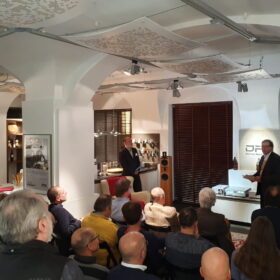
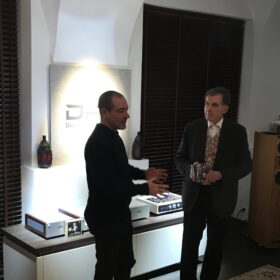
Impressions from the exclusive Advent Events in our Showroom

Here are some impressions from the exclusive events in our showroom in the Haus der Musik, Vienna, which we organised together with the Wiener Lautsprecher Manufaktur and the klangBilder Fair in November and December. Our guests enjoyed beautiful music, interesting and entertaining presentations and interviews as well as delicious Austrian wine … and celebrities: amongst others, Claudio Vandelli and Caroline Kreutzberger presented their latest CDs and offered insights into their artistic work.


Cover EinsNull Testbericht Model 2

Title Story: The HD-Player Model 2 reviewed by HiFi EinsNull

Quotes:

“The Model 2 reveals the advantages of the technical advancements of the last 30 years. The ladder DAC of the Model 2 sounds unbelievably good: It exudes ease and musicality. The sound stage is wonderfully open, instruments are given  lots of space to unfold, creating beautiful details and definition. The sonically deep background optimizes the presentation. The player reveals so many details.”

“Whoever finds modern music servers lacking in character, will have a lot of fun with the Model 2. The concept of the HD-Player perfectly marries classical and modern qualities and becomes the centre of a sophisticated hifi system.”

Checksum:

“The retro look of the HD-Player Model 2 is more than a design gimmick. Instead, the technically highly sophisticated server becomes a part of a serious hifi system.  Combining its design with fantastic sound quality and excellent user handling, DAS sets a new trend, which will hopefully be picked up and followed by many others.”

You can read th full article here (in German).